About This Initiative
Context
ACS Economic Security is a multi-year collaboration between the Administration for Children's Services (ACS) and its public and nonprofit partners. Together, we are building a citywide structure to support economic stability and upward mobility for families and youth in or at-risk of entering the child welfare and youth justice systems.
Our Approach
This program will integrate economic and concrete resources directly into child welfare and youth justice practice, providing families and young people across New York City with ongoing support to secure and maintain access to them.
Our Goals
- Stabilize families and support long-term economic mobility
- Improve family and child well-being
- Prevent involvement with child protection and youth justice services
- Reduce the likelihood of re-involvement (for families already involved)
How This Playbook Was Created
Through generative co-design workshops and a ten-week pilot period followed by another series of redesign workshops, almost 200 collaborators co-designed this digital playbook. They included ACS-involved families, staff and leaders at ACS and the Department of Social Services (DSS), and representatives from 14 ACS-contracted community-based organizations across New York City. Their input shaped the content, format, and scope of every section, process, and tool.
Initiative Timeline
ACS contracted with two nonprofit organizations, Public Policy Lab (PPL) and Chapin Hall, to support the project's design and evaluation.
Research Phase
PPL conducted research with families and young people receiving ACS services, as well as staff and leaders from ACS providers, DCP's Family Services Units (FSU) and Family Preservation Program (FPP), DSS, and the Department of Consumer and Worker Protection (DCWP). This included shadowing, interviews, process mapping sessions, and surveys. PPL used these insights to identify shared needs, develop design guidelines, and create a draft integrated service.
Co-Design Phase
The project team then brought together ACS and DSS program leaders, provider organizations, and families for three months of weekly workshops, led by PPL, to respond to and refine the draft service through collaborative design.
Testing and Redesign Phase
14 ACS teams and providers tested a working prototype of the Economic Security program model for ten weeks in Spring 2026. Staff from across these teams then participated in another series of workshops to redesign the program based on their experiences.
Rollout
PPL and Chapin Hall are helping ACS and its providers build the long-term infrastructure needed to implement the program. The full rollout across ACS and contracted providers will happen over 1-2 years.
Intended Impact
Our Goal
We will directly support families and young people to address their economic and concrete needs, reducing the risk of child welfare and youth justice involvement. Using a continuous quality improvement approach through strengthening practice, tracking data, and analyzing outcomes, we will demonstrate that investing in economic and concrete resources and supports strengthens financial stability, improves economic mobility, and improves child welfare and youth justice outcomes.
Economic Security Support
We aim to connect families to resources and supports including, but not limited to:
- Public Benefits: Cash assistance, SNAP, SSI/SSD, WIC, low-income energy assistance, Fair Fares
- Affordable Housing & Support Services: Rental vouchers (city, state, or federal), permanent supportive housing, NYCHA public housing, ACS housing rental subsidy, HPD-financed affordable housing
- Eviction Prevention: Rent arrears payments, legal services
- Health Insurance & Navigation: Medicaid and Medicare, Affordable Care Act marketplace plans, Metro Plus
- Child Care & Pre-K: child care vouchers, Head Start, pre-K, child care navigation services
- Free Tax Filing & Financial Services: Earned Income Tax Credit, federal and state Child Tax Credit, financial coaching and services
- Employment Services and Training: Employment and career services, business development, training and education
- Flexible Funds: Cash and funding for immediate needs not met by other sources (e.g., diapers, crib/furniture, food, clothes)
Four Components of this Initiative
ACS Economic Security has four components designed to address the economic needs of families and young people and reduce the risk of child welfare and youth justice involvement:
- Establish Program Infrastructure: Create scalable, sustainable program models that provide lasting access to economic security supports for families and young people during and after system involvement.
- Strengthen Organizational Connections: Build connections and navigation supports across human services, housing, workforce, and community-based organizations to create stability and pathways to economic mobility for families and young people.
- Increase Shared Capacity: Build workforce knowledge and skills to effectively assess poverty-related needs and connect families to public benefits, housing, and other economic security supports.
- Address Policy Gaps: Identify and advocate for critical policy and resource investments, including new economic supports, to close systemic gaps and actively support families' financial stability and upward mobility.
Background
This initiative is grounded in the experiences of professionals across the public and nonprofit sectors and the voices of families and young people with lived experience in NYC's child welfare system. It builds on growing evidence showing the connections between poverty and child welfare outcomes1 and demonstrating that economic support and cash assistance lead to better outcomes within the child welfare system 2, 3, 4, 5, 6, 7, 8, 9, 10.
The Evidence
Poverty drives child welfare involvement. Economic insecurity and financial stress have been shown to increase the risk of child welfare system involvement11, including both alleged and substantiated neglect and abuse. Insufficient resources and living in economically struggling neighborhoods can cause parental stress, mental health issues, and strained family dynamics—all of which negatively impact children's well-being12. Housing instability is one of the strongest economic predictors of child welfare involvement13 and foster care entry13.
Economic supports improve outcomes. Studies show that securing and maintaining economic and concrete supports improves child welfare outcomes2, 3, 4, 5, 6, 7, 8, 9, 10:
- The Earned Income Tax Credit (EITC) is linked to improved maternal mental health, reduced stress-related biomarkers, enhanced family well-being, decreased abusive head trauma in young children, and reduction in foster care entry rates. Each additional $1,000 in per-child refunds leads to fewer maltreatment reports.
- Access to TANF and SNAP correlates with reductions in child welfare involvement and foster care caseloads15, 16, 17, 18.
- Young people with stable housing are better able to stay in school, maintain employment19, 20, and access physical and mental health care and social services21.
How the Program Works
ACS Economic Security connects families and young people in ACS programs with support to strengthen their economic stability and mobility. At the core of the program is the young person or family's engagement with an ACS program—either through an FSU team or through an ACS provider. The following scenarios outline the alternative ways the four key parts the program can be achieved:
Scenario A
A child welfare worker (Case Aide, Parent Advocate, Family Worker, etc.) acts as an Economic Resource Navigator.
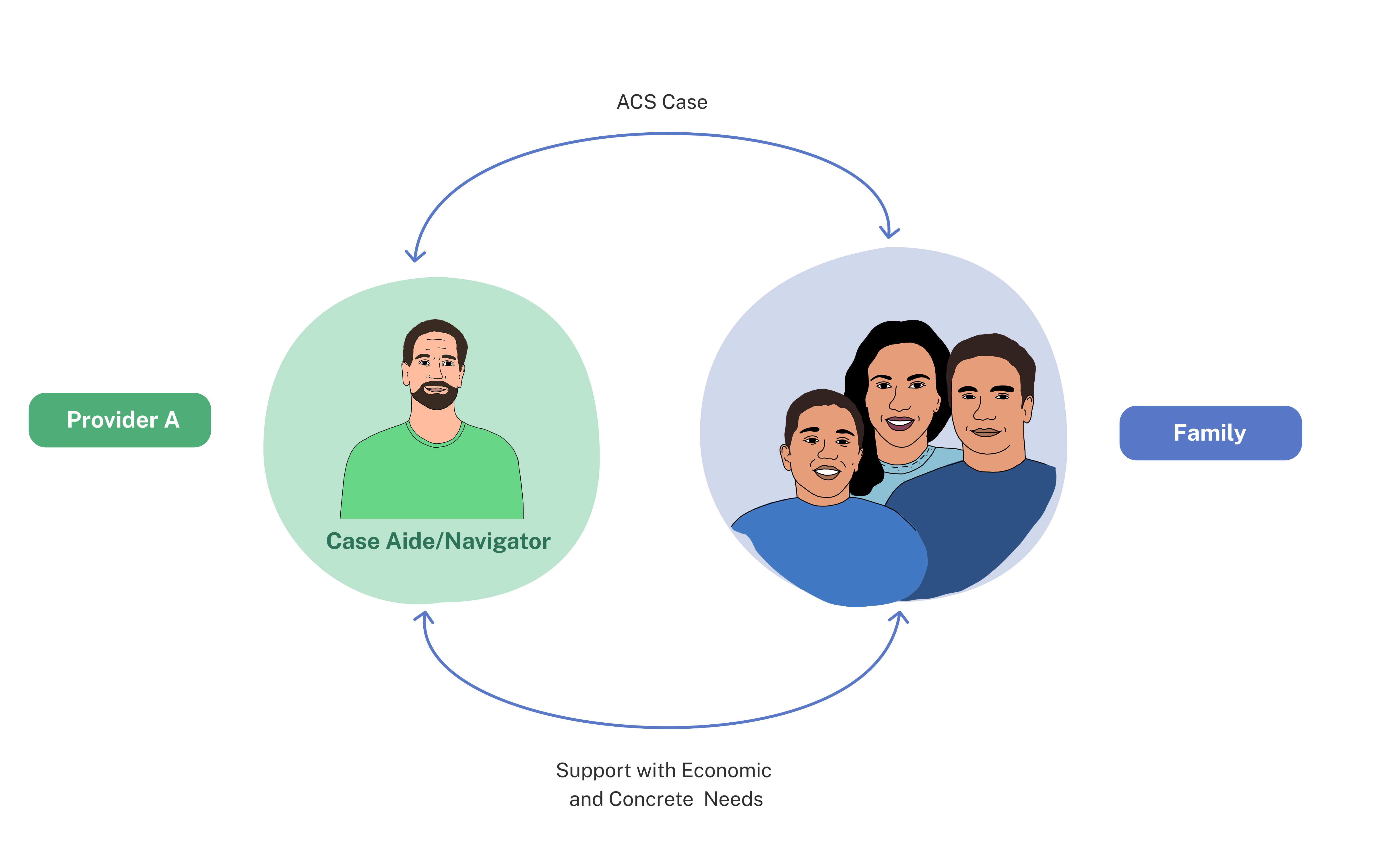
- Screen for needs. The program begins with screening for unmet Economic Security needs (see Activity 1). This might happen during intake or another early meeting with the child welfare worker or manager. Screening can be conducted by the primary child welfare worker or by another role who will also act as an Economic Resource Navigator, such as a Case Aide, Parent Advocate, or Family Worker. Screening happens early, and re-screening happens at regular milestones throughout the child welfare case unless a referral is eventually made to a dedicated Economic Resource Navigator who is outside of the child welfare team.
- [No referral is needed to Economic Resource Navigators, as they are part of the child welfare team and are already working with the family or young person.]
- Economic Resource Navigators provide support. After the introductory meeting between the child welfare worker, ERN (Case Aide, Parent Advocate, Family Worker, etc.), and family or young person, the ERN continues working with the family or young person to understand and address their Economic Security needs (see Activity 3). The child welfare worker manages the ACS case, and the ERN regularly checks in with them to align on economic security needs and progress toward addressing them.
- Support continues after case closure. When the ACS case closes, the ERN can continue working with the family or young person on their economic security needs or determine if an external referral is needed for further economic security support (see Activity 4).
Scenario B
The child welfare worker or manager refers the family or young person to a dedicated in-house Economic Resource Navigator.
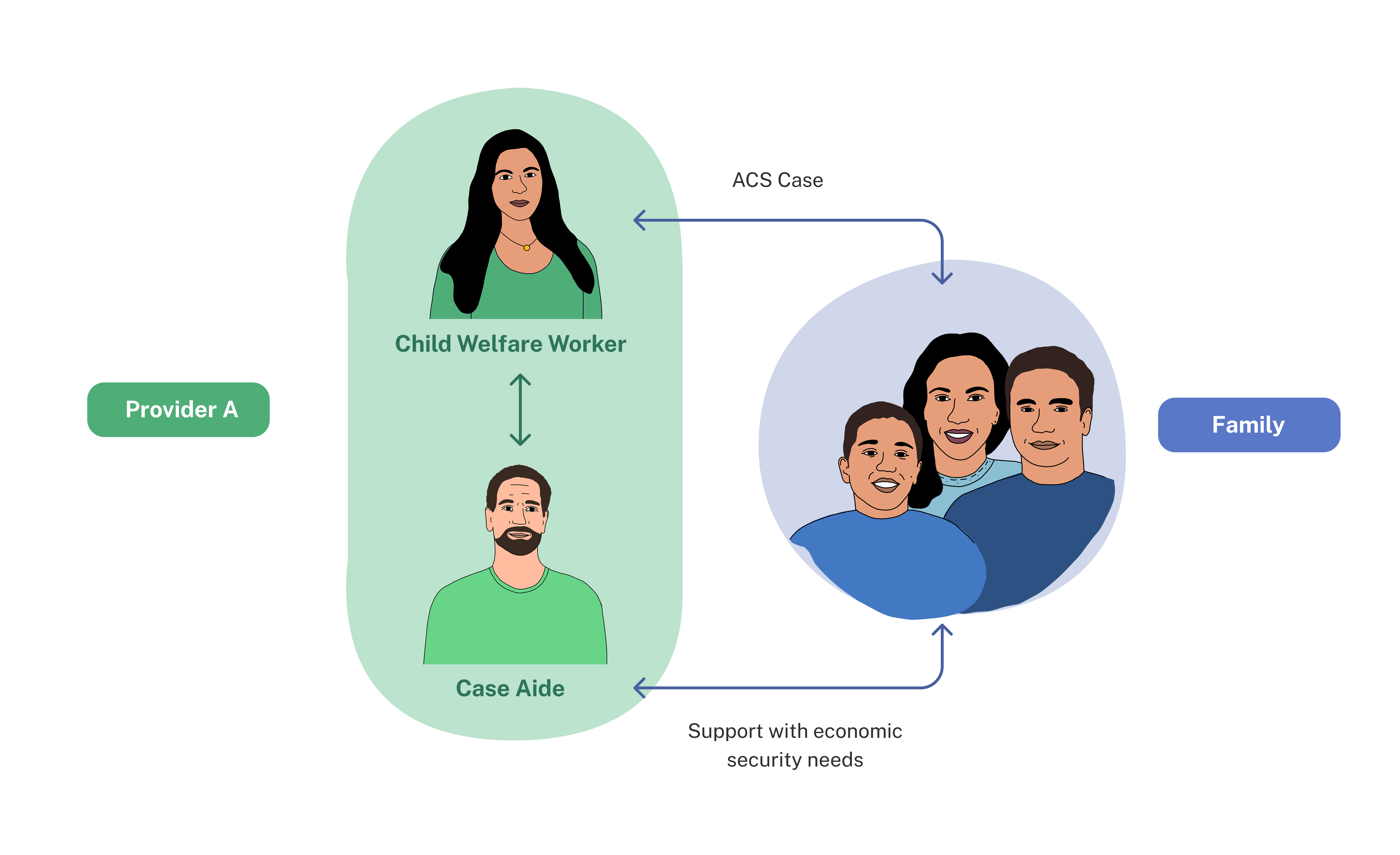
- Screen for needs. The primary child welfare worker screens for unmet economic security needs (see Activity 1) during intake or another early meeting. They re-screen at regular milestones throughout the child welfare case until they make a referral to an ERN.
- Refer to a dedicated in-house ERN. If the family or young person has economic security needs that require eligibility assessment, application support, or referral beyond the knowledge or expertise of the child welfare worker, the child welfare team should make an internal referral to a dedicated ERN at the same organization (see Activity 2). ERNs are staff whose dedicated capacity is funded through ACS or NYCBenefits contracts.
- ERNs provide support. The ERN continues working with the family or young person to understand and address their economic security needs (see Activity 3). The child welfare worker manages the ACS case, and the ERN regularly checks in with them to align on economic security needs and progress toward addressing them.
- Support continues after case closure. When the ACS case closes, the ERN can continue working with the family or young person on their economic security needs or determine if an external referral is needed for further economic security support (see Activity 4).
Scenario C
The child welfare worker or manager refers the family or young person to a dedicated Economic Resource Navigator at an external organization.
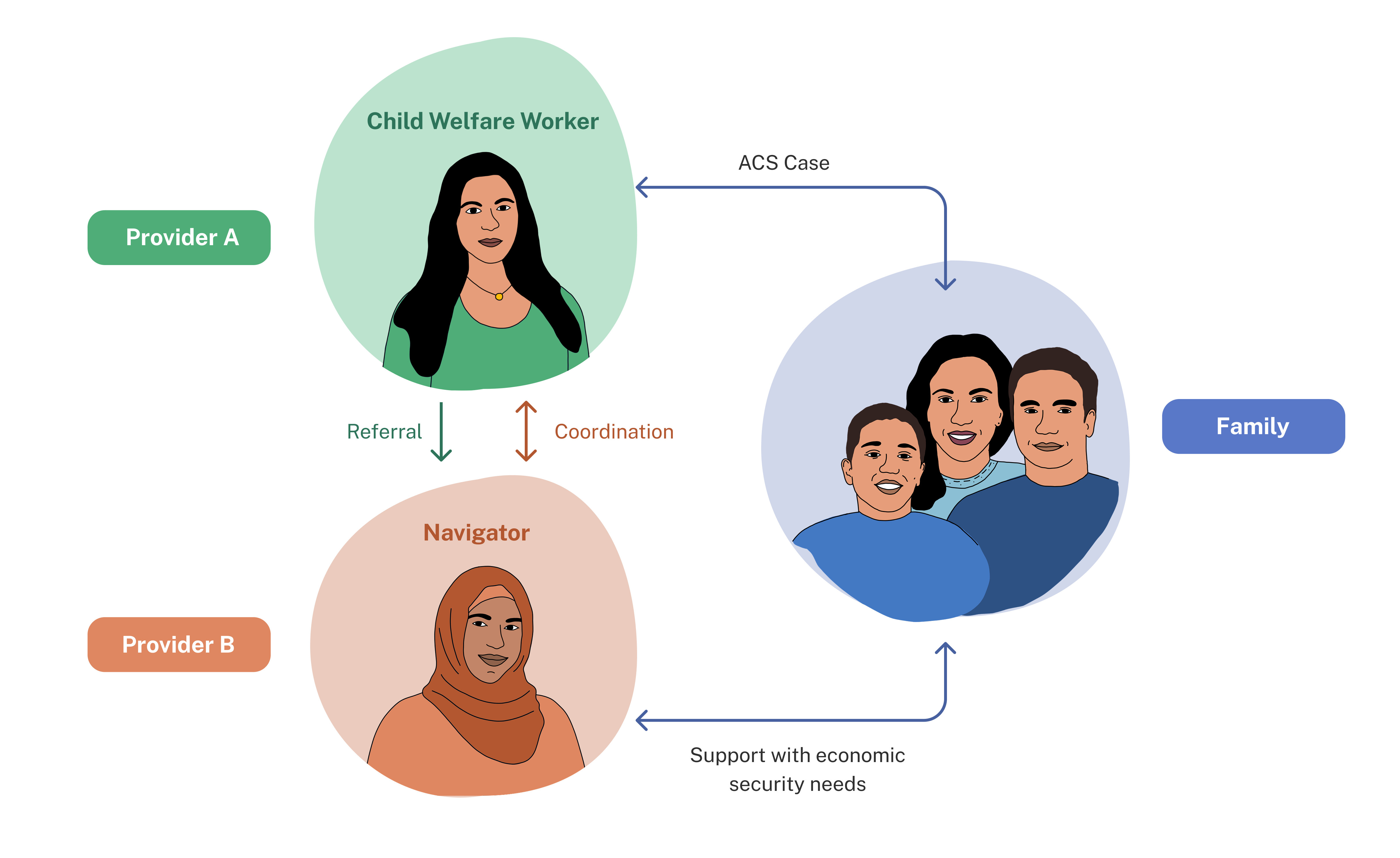
Some teams and organizations might not have an in-house ERN. Or the family or young person might prefer to work with an ERN at another organization based on location, reputation, cultural or language preferences, or a desire to keep their ACS case separate from their economic needs.
- Screen for needs. The primary child welfare worker screens for unmet economic security needs (see Activity 1) during intake or another early meeting. They re-screen at regular milestones throughout the child welfare case until they make a referral to an ERN.
- Refer to a dedicated ERN at an external organization. If the family or young person has economic security needs that require eligibility assessment, application support, or referral beyond the knowledge or expertise of the child welfare worker—and there are no options for in-house ERNs—they explore a directory of options to refer to an ERN at an external organization (see Activity 2). When that organization confirms capacity to take on the referral, the child welfare worker submits a referral and coordinate a warm handoff (ideally, an in-person meeting with the family or young person making a phone call to the ERN).
- ERNs provide support. The ERN continues working with the family or young person to understand and address their economic security needs (see Activity 3). The child welfare worker manages the ACS case, and the ERN regularly checks in with them to align on economic security needs and progress toward addressing them.
- Support continues after case closure. When the ACS is nearing closure, the ERN provides final updates to the referring child welfare worker. The ERN can continue working with the family or young person on their economic security needs or determine if an external referral is needed for further economic security support (see Activity 4).
References
- Chapin Hall. (2025). A key connection: Economic stability and family well-being. https://www.chapinhall.org/project/a-key-connection-economic-stability-and-family-well-being/
- Cancian, M., Cook, S. T., Seki, M., & Wimer, L. (2017). Making parents pay: The unintended consequences of charging parents for foster care. Children & Youth Services Review, 72, 100-110. https://doi.org/10.1016/j.childyouth.2016.10.018
- Howard, L., Vogel, L. K., Cancian, M., & Noyes, J. L. (2019). Building connections: Using integrated administrative data to identify issues and solutions spanning the child welfare and child support systems. RSF: The Russell Sage Foundation Journal of the Social Sciences, 5(2), 70-85. https://doi.org/10.7758/RSF.2019.5.2.04
- Wells, K., & Guo, S. (2006). Welfare reform and child welfare outcomes: A multiple cohort study. Children & Youth Services Review, 28(8), 941-960. https://doi.org/10.1016/j.childyouth.2005.10.009
- Kang, J., Romich, J. L., Hook, J. L., Lee, J. S., & Marcenko, M. (2016). Dual-system families: Cash assistance sequences of households involved with child welfare. Journal of Public Child Welfare, 10(4), 352-375. https://doi.org/10.1080/15548732.2016.1205542
- Berger, L. M., Font, S. A., Slack, K. S., & Waldfogel, J. (2017). Income and child maltreatment in unmarried families: Evidence from the earned income tax credit. Review of Economics of the Household, 15(4), 1345-1372. https://doi.org/10.1007/s11150-016-9346-9
- Biehl, A. M., & Hill, B. (2018). Foster care and the Earned Income Tax Credit. Review of Economics of the Household, 16(3), 661-680. https://doi.org/10.1007/s11150-017-9381-1
- Kovski, N. L., Hill, H. D., Mooney, S. J., Rivara, F. P., Morgan, E. R., & Rowhani-Rahbar, A. (2022). Association of state-level earned income tax credits with rates of reported child maltreatment, 2004–2017. Child Maltreatment, 27(3), 325-333.
- Klevens, J., Schmidt, B., Luo, F., Xu, L., Ports, K. A., & Lee, R. D. (2017). Effect of the Earned Income Tax credit on hospital admissions for pediatric abusive head trauma, 1995-2013. Public Health Reports, 132(4), 505-511. https://doi.org/10.1177%2F0033354917710905
- Rostad, W. L., Ports, K. A., Tang, S., & Klevens, J. (2020). Reducing the number of children entering foster care: Effects of state earned income tax credits. Child Maltreatment, 25(4), 393- 397. https://doi.org/10.1177/1077559519900922
- Patel, Urvi and Shrivastava, Aditi. (2023). Research Reinforces: Providing Cash to Families in Poverty Reduces Risk of Family Involvement in Child Welfare. Center on Budget and Policy Priorities.
- Conger, R. D., Ge, X., Elder Jr, G. H., Lorenz, F. O., & Simons, R. L. (1994). Economic stress, coercive family process, and developmental problems of adolescents. Child Development, 65(2), 541-561. https://doi.org/10.1111/j.1467-8624.1994.tb00768.x
- Conrad-Hiebner, A., & Byram, E. (2020). The temporal impact of economic insecurity on child maltreatment: A systematic review. Trauma, Violence, & Abuse, 21(1), 157-178. https://doi.org/10.1177/1524838018756122
- Fowler, P. J., Henry, D. B., Schoeny, M., Landsverk, J., Chavira, D., & Taylor, J. J. (2013). Inadequate housing among families under investigation for child abuse and neglect: Prevalence from a national probability sample. American Journal of Community Psychology, 52(1), 106-114. https://doi.org/10.1007/s10464-013-9580-8
- Austin, A. E., Shanahan, M. E., Frank, M., Naumann, R. B., Reyes, H. L. M., Corbie, G., & Ammerman, A. S. (2023). Association of state expansion of Supplemental Nutrition Assistance Program eligibility with rates of Child Protective Services–investigated reports. JAMA Pediatrics, e225348. https://doi.org/10.1001/jamapediatrics.2022.5348
- Bullinger, L. R., Fleckman, J. M., & Fong, K. (2021). Proximity to SNAP-authorized retailers and child maltreatment reports. Economics & Human Biology, 42, 101015.
- Johnson-Motoyama, M., Ginther, D. K., Oslund, P., Jorgenson, L., Chung, Y., Phillips, R., Beer, O. W., Davis, S., & Sattler, P. L. (2022). Association between state Supplemental Nutrition Assistance Program policies, child protective services involvement, and foster care in the US, 2004-2016. JAMA Network Open, 5(7), 1-12.
- Lee, B. J., & Mackey-Bilaver, L. (2007). Effects of WIC and food stamp program participation on child outcomes. Children & Youth Services Review, 29(4), 501-517.
- Johnson, G., Natalier, K., Mendes, P., Liddiard, M., Thoresen, S., Hollows, A., & Bailey, N. (2010). Pathways from out-of-home care. AHURI Final Report No.147. Melbourne, Australia: Australian Housing and Urban Research Institute.
- Sommer, H., Wu, L., & Mauldon, J. (2009). California Connected by 25: Efforts to Address the Housing Needs of Transitioning Foster Youth. Berkeley, CA: CC251 Systems Change Assessment Team.
- Wade, J., & Dixon, J. (2006). Making a home, finding a job: investigating early housing and employment outcomes for young people leaving care. Child and Family Social Work, 11, 199-208